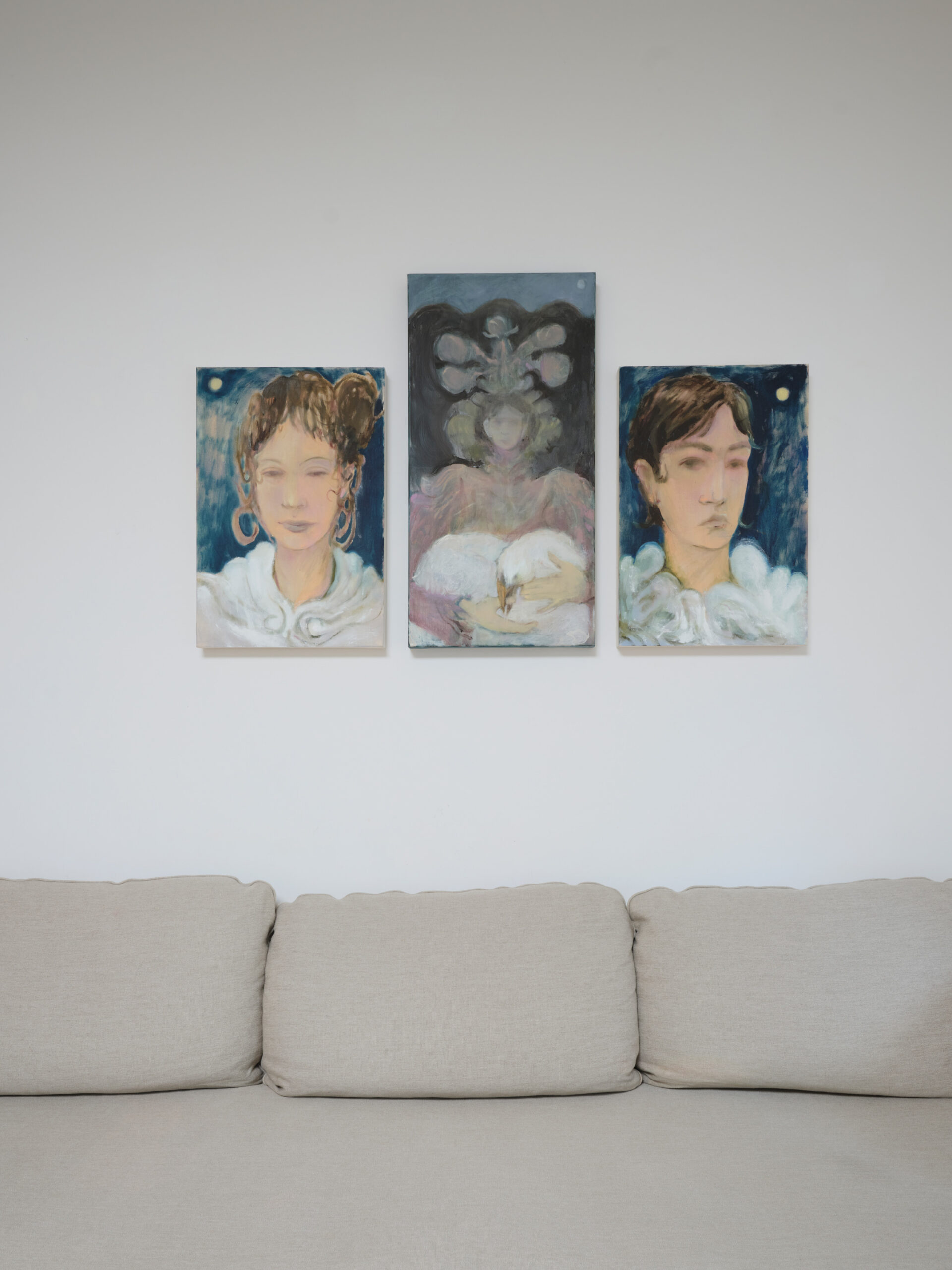
Princess of the Three Hills
Once upon a time there was a princess who ruled over the land of Three Hills. And as one would imagine, this princess was very beautiful — some would say the most beautiful in the land (well, at least that’s what we think…because we don’t really know and anyway there’s almost never a case of an ugly princess). We first meet her when she is 16; an age that is impressionable yet powerful, full of wilds of the mind metered by the pressures that such privilege accompanies, especially for that of a teenager, whose synapses are being cut so rapidly and haphazardly that control of anything — mind, body, spirit — is a cruel joke that plays out in the most unforgiving of ways. By the way, did you know that the term “teenager” has only been used since the mid 20th century? Some six centuries after the lifetime of our sweet girl? I digress. It’s sometime during the 14th century, and our dear princess reigns over a land which would now be modern-day Poland, particularly the Mazovian region — an area and clan renowned for its powerful matrilineal society, known as the mazonki. Her kingdom is filled with symbols: daisies and geese; horses, lambs, entwined roots, and fluttering butterflies. The landscape is fertile and the hills are rolling; her doting ladies-in-waiting do what they can to appease their friend-cum-ruler, and the boys lay suspended in hypersomnia until awoken…perhaps by a princess’s kiss?
To really know our princess, we have to go back a bit to the time when she was just twelve, and still brimming with the innocence of childhood. One day, she went walking through the woods where she encountered a very special little goose. Something inexplicable drew her to him, so she decided to keep the animal and name him Isodora. The little girl, our princess, loved Isodora more than anything in the world, and so to show him this love, she fed him and fed him and fed him, unendingly. This could only obviously carry on for a short time until one day, sweet little Isodora succumbed to the forced gluttony. This devastating turn imprinted a pernicious entanglement in our innocent princesses’ developing brain, where feeding, love, cruelty, and death became inextricably linked, and no other goose could ever compare to the beloved, smothered Isodora — he would leave a void in the heart of our princess that would remain forever unfilled.
As our princess grew, so did her shadow. Deeply alone and misunderstood, she was unable to fill the emptiness within her — the first cracks of which emerged from the loss of Isodora, followed by the abrupt abandonment by her mother, Aqualiteja (modeled after the 21st century Polish pop star Doda), who had gone off in pursuit of her own dreams. Our poor, dear girl was left to assume power and become a woman while struggling through the brambles of her own chaotic and unforgiving teenage intellect, left to raise herself and rule over her land in the presence of her absent mother.¹
This profound hollow was impossible to heal, and forced our princess into a space of deep existential crisis — a distressingly timeless and relatable course for the teenage girl species. The princess unendingly questioned her own desires and contended with self-awareness, autonomy, ambivalence, objectivity, and absolute power. She was conflicted by the perennial need to be loved and the need to break from the roles that bound her to men, their power, and the legacies that have colonized lands and bodies ad infinitum. In hindsight, she will one day ask, “what would art history look like if it emerged not from a Catholic order, but from a system attuned to natural cycles, matrilineal power, and the inner cosmologies of adolescent girls?”
There is no resolution to her saga and nothing that would ultimately fill the canyons within her carved by mother and goose, it is only time and age that has the power to soften such walls.
But the story of our princess and her world of Three Hills is an imaginary — peppered with facts and historical accounts — of ethnofictionist Julia Woronowicz. It is a confluence of myth, memory, and neurobiology, where time and place are situated somewhere between constructed fantasy and unvarnished emotional realism. Technically, the works are built from a balance of pastels and earth tones and are textile-like in their surfaces, which gently proposes greater proximity to body and land over painting and object. At times, her faces dissolve into their compositions, offering a dreamlike and disquieting inability to be grasped—perhaps it is a refusal to be “fixed” during the process of becoming?
Woronowicz uses collected diary fragments from both friends and strangers, as conceptual prompts and eventual titles of works. These texts, always partial, serve as whispers from that interstitial age — private, hyper-emotional, marked by longing and confusion. They are the interior monologues of individuals, mostly girls, who, despite the hypernormalized performance of innocence through beauty, harbor complexity, rage, cruelty, and power.
Woronowicz confronts the toxic myth of the “good girl” with clarity: as beauty does not equal kindness. In fact, in many of her works, the beauty that emerges during teenagehood becomes a dangerous tool—to be envied, traded, and controlled. And as Woronowicz notes with deep empathy, this time of teenagehood is not just a cultural trope but a biological condition. Between the ages of 12 and 17, the brain undergoes massive rewiring — synaptic pruning that produces volatility, mood swings, and emotional disorientation. It comes as no surprise that these girls refuse to be named, or truly seen.
Beauty and blur, power and innocence are not the only tropes that recur; daisies are desecrated and geese become stand-ins for girlhood itself. And the motif of sleeping — so central to familiar fairytales like Sleeping Beauty — emerges here not as a metaphor for passivity but as a psycho-somatic condition where sleep is a form of protest or escape. Woronowicz’s sleeping boys, paralyzed by emotional overwhelm, retreat into unconsciousness when their bodies can no longer resist or fight, process or comprehend.
An homage to the complexity of being a teenage girl, Princess of the Three Hills is an evolving story. It is not moralized, but rather serves as a documentary — a testament, or perhaps even monument — to the messiness and cruelty, tenderness and truth, that in theory, is the path to a life lived happily ever after.
___________________
¹ The figure of the absent mother, also known as “The Dead Mother Complex”, is characterized by a mother who is physically alive yet emotionally unavailable or absent, for example, due to the inability to process her own trauma or grief. It is a clinical condition introduced by French psychoanalyst André Green in the early 1980s.
Text by Katie Zazenski